Updated
Where the word comes from
Strata is Latin for layers. A strata plan divides a building into layers of private space, one lot at a time, with the shared parts wrapped around them. The same idea covers apartment towers, townhouse rows and a pair of units sharing a driveway.
It’s a big part of how Australia lives. There are almost 368,000 strata and community schemes across the country, holding more than 3.1 million lots, and about one in six Australians live in one.
The names change at each state border, and the ACT and the Northern Territory say unit titles instead of strata. Our guide to strata law, state by state has the terms and Acts for each one. This page uses New South Wales as the example.
What the owners are called, together
- Owners corporation. NSW, ACT, Vic
- Body corporate. NT, Qld, Tas
- Strata company. WA
- Community or strata corporation. SA
What you own, and what you share
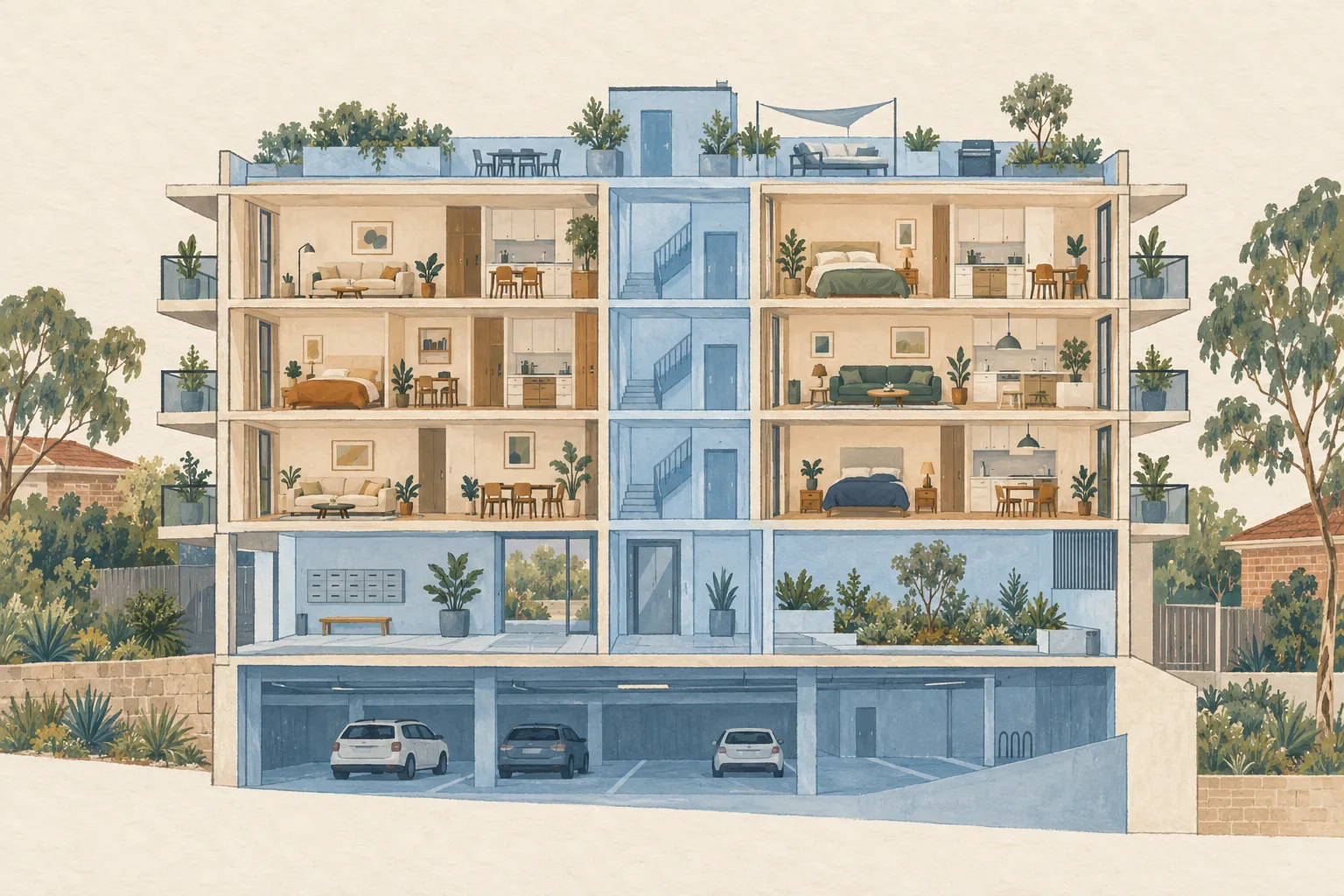
Under the Strata Schemes Development Act 2015, unless the strata plan says otherwise, a NSW lot stops at the inside face of its walls, the top of its floor and the underside of its ceiling. The paint, the carpet and the kitchen are yours. The structure around them, the slab, the outside walls and the roof, belongs to everyone.
Your lot. The space inside your walls, above your floor and below your ceiling.
Your neighbours' lots. Each one owned outright by someone else.
Common property. Everything else, owned by all the owners together: the structure, roof, outside walls, lift, stairs, foyer, garden and car park.
That line decides who pays when something breaks.
Priya NairLot 14
“Water is coming through my bathroom ceiling from upstairs. Is that my problem or the building’s?”
The owners corporation fixes
- Roof and gutters
- Boundary walls
- The concrete floor slab
- Pipes in boundary walls and under the floor
- Water damage that starts in common property
The lot owner fixes
- Internal walls
- Pipes in internal walls
- Bath, toilet, sinks and shower
- Water damage that starts inside the lot
So Priya’s answer depends on where the water started. A pipe in the slab or a boundary wall is common property, so it’s the owners corporation’s job. A leaking shower inside the apartment upstairs points to that owner. Either way the building’s insurance may step in, which our guide to strata insurance explains.
Levies: what you pay, and why
Every owner pays levies, which the Strata Schemes Management Act 2015 calls contributions. The owners set them each year at the annual general meeting, based on a budget for two funds:
- The administrative fund covers everyday running costs, such as cleaning, gardening, insurance, power for the common areas and the strata manager’s fees.
- The capital works fund saves for big jobs like a new roof, lift upgrades or repainting. It used to be called the sinking fund, which is still the name in Queensland and the ACT. Every NSW scheme needs a 10 year plan for it, reviewed at least every five years.
Your share follows your lot’s unit entitlement, a number on the strata plan set by a valuer when the scheme was created. A larger apartment with the view usually carries a bigger entitlement than a studio facing the car park, so it pays more of every bill. Victoria splits this in two, with lot entitlement for ownership and votes and lot liability for costs. Queensland also keeps two schedules, one for costs and one for ownership.
Harbourview Apartments
Levy notice for Lot 14, Priya Nair
| Fund | Building’s yearly budget | Your quarter |
|---|---|---|
| Administrative fund | $112,400 | $1,180.20 |
| Capital works fund | $61,000 | $640.50 |
| Due 15 November 2026 | $1,820.70 | |
Includes the Financial Hardship Information Statement that NSW levy notices now carry.
Lot 14’s unit entitlement
42 of 1,000
So Lot 14 pays 4.2% of each budget, every quarter, whatever the bill is for.
If the funds fall short, owners can vote for a special levy. In NSW a levy is due at least 30 days after notice, or 14 days for emergency repairs. Buyers should know that unpaid levies stay with the lot: a new owner becomes liable for them along with the old one.
By-laws: the building’s rules
By-laws set out how owners and tenants use their lots and the common property: noise, pets, parking, rubbish, smoking on balconies, renovations. Many NSW buildings start from the model by-laws in the Strata Schemes Management Regulation 2016 and add their own.
A by-law can’t be harsh, unconscionable or oppressive, and it can’t unreasonably stop you keeping a pet. Queensland goes further: a by-law there can’t ban animals at all, only require approval. Changing one takes four steps:
Motion
Put to a general meeting of the owners.
Special resolution
Passes unless more than 25% of the votes cast are against it.
Lodged
With the NSW Registrar-General, within six months.
In force
Only once it's recorded. Until then the old by-law stands.
If someone keeps breaking a by-law, the owners corporation can send a notice to comply and then ask the NSW Civil and Administrative Tribunal for a fine of up to $1,100 for a first breach.
Who runs the building
Owners corporation
Every owner. Votes on the big decisions at general meetings, including the AGM.
Strata committee
Up to nine owners, elected at each AGM. Makes day-to-day decisions between meetings.
Strata manager
A licensed agent hired by the owners. Runs levies, meetings, records and repairs.
In NSW the owners meet at least once every financial year for the annual general meeting, with at least 14 days’ notice. The NSW Government says that from 1 October 2026, committee members must complete free online training within three months of being appointed. A strata manager must hold a strata managing agent licence under the Property and Stock Agents Act 2002, and smaller buildings often manage themselves.
One thing surprises new owners: the strata manager works for the owners corporation, not for any single owner. They carry out what the owners and the committee decide.
Renovating a strata apartment
What you can change on your own depends on how much of the building it touches.
- Step 1Cosmetic workPainting, hanging pictures, new carpetNo approval
- Step 2Minor renovationsA new kitchen, hard floorsOrdinary resolutionCan't be unreasonably refused
- Step 3Changes to common propertyRemoving part of a structural wallSpecial resolutionPasses unless over 25% of votes are against
Buying into strata: what to check
Before you sign, read the owners corporation’s records, and check for any levies owing on the lot. Four things tell you the most:
- Meeting minutesDefects, disputes and special levies on the way.
- Capital works fundA thin fund and an old roof mean a special levy later.
- By-lawsPets, short stays, parking and renovations.
- InsuranceRecent claims, and how fast the premium is rising.
In Queensland, since 1 August 2025, the seller must give you a body corporate certificate and the community management statement before you sign.
Sources
- Strata Schemes Management Act 2015 (NSW)
- Strata Schemes Development Act 2015 (NSW)
- NSW Government: repairs and maintenance
- NSW Government: levies, finances and insurance
- NSW Government: by-laws
- NSW Government: strata committee training
- Consumer Affairs Victoria: owners corporation definitions
- Queensland Government: lot entitlements
- Queensland Government: seller disclosure
- UNSW City Futures and Strata Community Association: 2024 Australasian Strata Insights (reissued October 2025)